1.1
Multi-agent system for technical research
- Goal
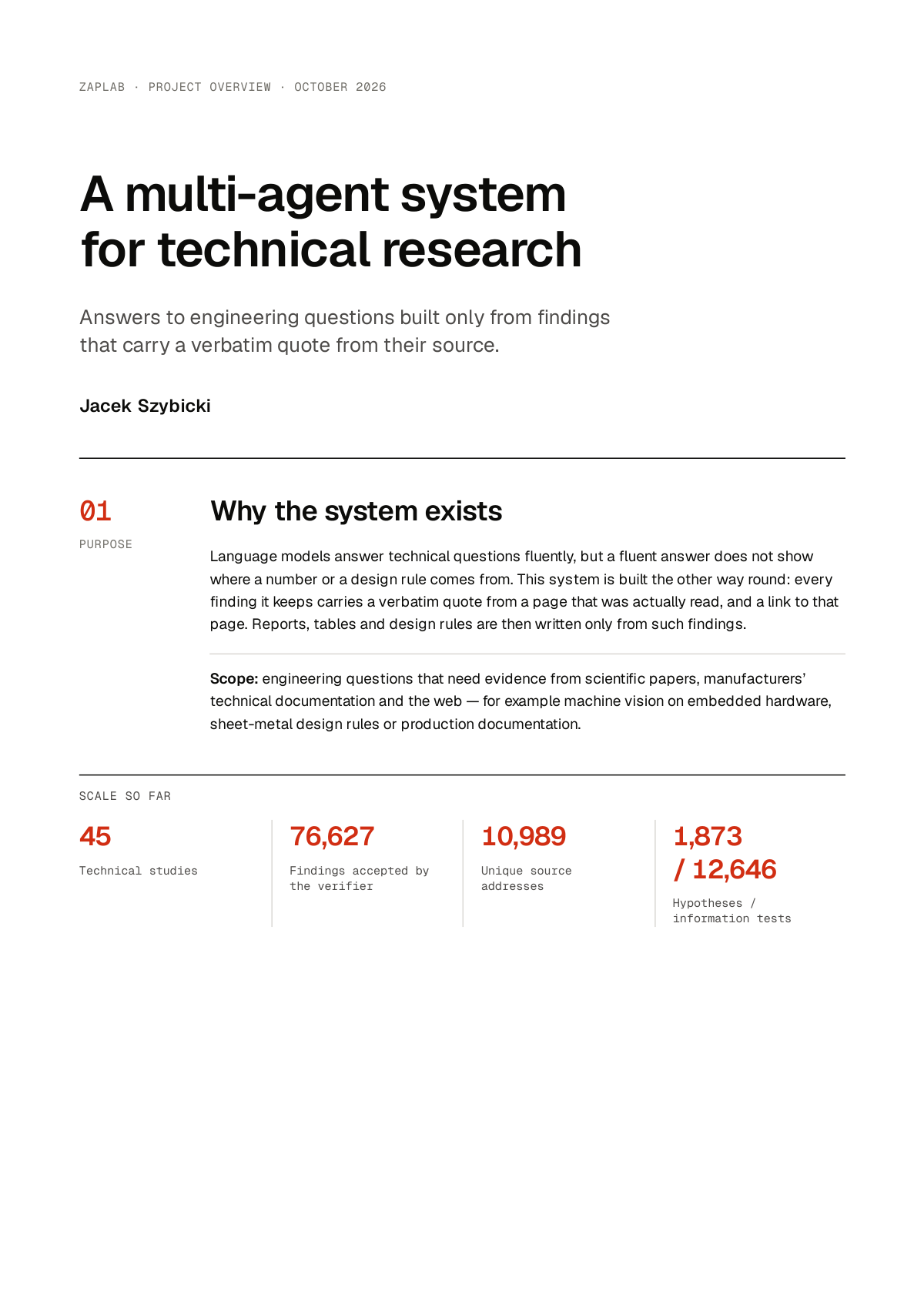
- Answers to technical questions built only from findings that carry a quote from their source.
- How it works
- A question is split into cells. In each cell agents set out several competing hypotheses and plan tests, about a third of which look for evidence against them. Researchers read papers and documentation, a sceptic raises alternative explanations, and code computes each hypothesis’s confidence from independent sources.
- Verification
- A finding stays only if its quote is on the page that was read. A fine-tuned Qwen3.5-4B checks this (LoRA trained on 1,700 Claude judgments): 0.929 agreement with Claude, against 0.674 for the previous 27B verifier.
- Stack
- Open Qwen3.8-27B model served with vLLM on rented GPUs; sources from arXiv, OpenAlex, Crossref, Europe PMC and the web through a private search engine. Semantic Scholar is integrated and waits for an API key.
- 45technical studies
- 76,000+findings with a source quote
- 0.929verifier agreement with Claude
- $1–3GPU cost of a typical study
Finding
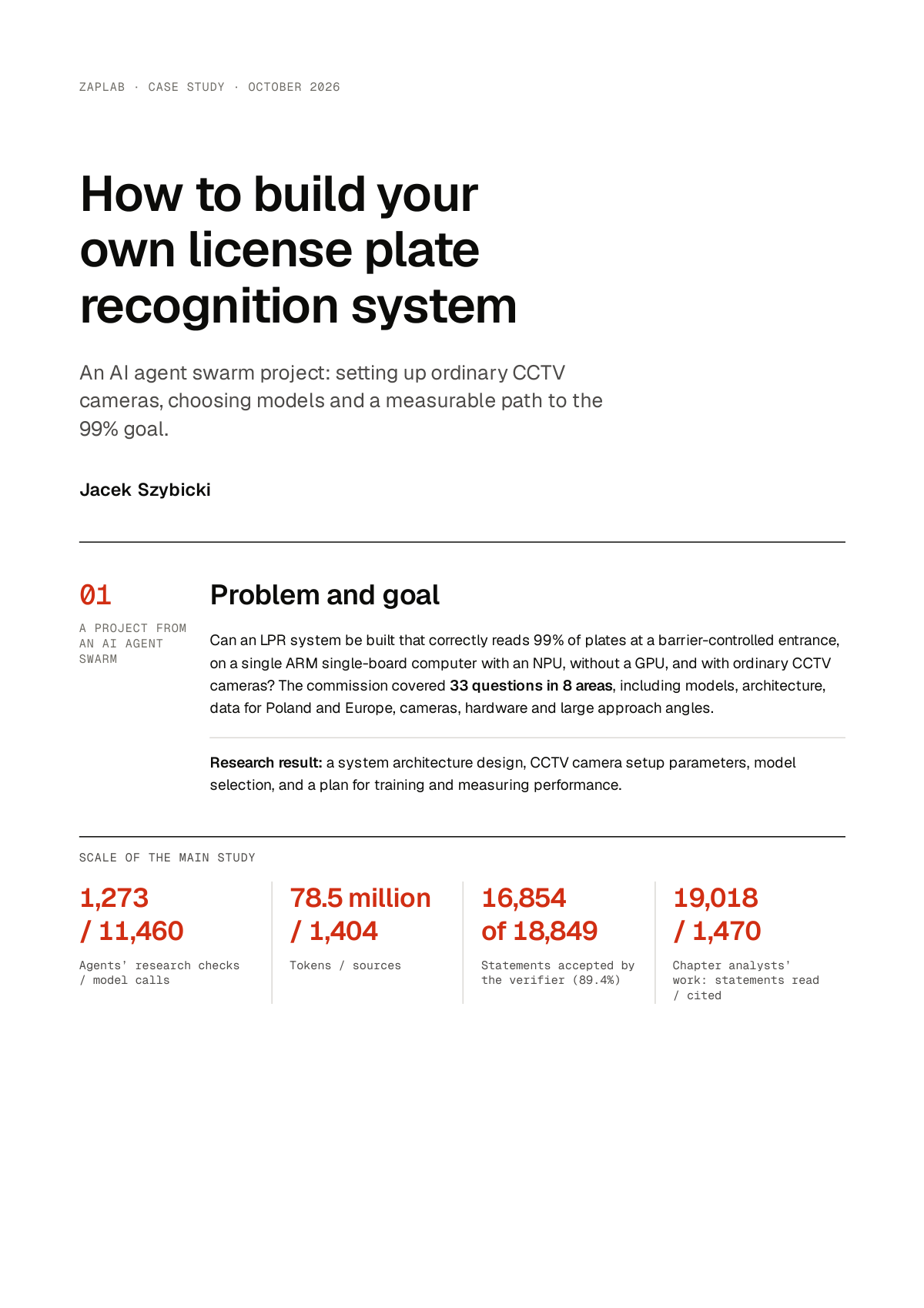
The character recognition model achieves 100% LP-RR with a minimum character size of 8×16 pixels, and the recognition rate drops below 36.4% when characters are smaller than 5×10 pixels.
Verbatim quote
“the character recognition model shows a 100% LP-RR with a minimum character size of 8 × 16 pixels. Then the recognition rate dramatically decreases under 36.4% when the characters feature a spatial size smaller than 5 × 10 pixels”
Source
Low-Power License Plate Detection and Recognition on a RISC-V Multi-Core MCU-Based Vision System
Quote found on the source page